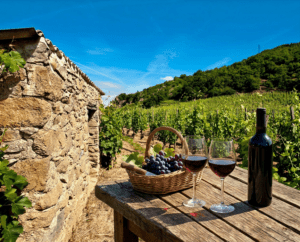
 Just when you think you’re a little worldly, you meet Sandra Combat, and realize you still have a long way to go. There she stands, this diminutive French winemaker who looks less than 30, with a name that sounds like she’s about to drop you with a corkscrew. Sandra was born in the Crozes-Hermitage region of France, the home of Syrah. She was the first female born to the Combat family in 100 years.
I’m not kidding.
And if you think that alone makes her a little different, she also speaks Mandarin like she was born in Beijing, and has notched 24 wine countries on her passport.
It was March 30. Crozes-Hermitage was making its debut trade visit to Toronto at The Dorset, an Oliver & Bonacini-bannered restaurant ironically renowned for its fine British cuisine. There were 120 wines lined up—the vast majority of them Syrah; the rest an assortment of Marsanne, Roussanne and sparkling—each begging for a sip.
As with most wine events, though, one has to pick and choose, because you’re not getting through them all—not without a liver transplant anyway. It was while selectively working my way through the various stations that I met Sandra, head winemaker at Domaine des Combat. Although the winery was founded just nine years ago, Combat family ancestor Louis Combat was part of the group of winegrowers who founded the nearby Cave de Tain l’Hermitage in 1933, and the Combat family has been farming these grounds since the 17th century. So, ya, they know what they’re doing.
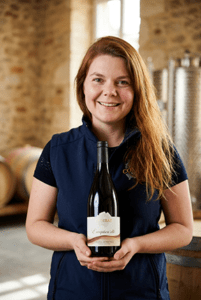
Domaine des Combat head winemaker Sandra Combat.
“What makes Syrah special,” I ask Sandra. “It’s the best grape on earth,” she smiles, as though it’s obvious. One minute it’s a fruity, spicy lightweight for backyard barbecues, the next a structured beast that pins you to the chair, she explains. Old vines, cellar wizardry, terroir—granite, limestone, clay—it’s the grape that shape-shifts like nobody’s business.
I’m a big fan too. The standout aroma is black pepper from rotundone in the grape skins. For most folks, it’s detectable at very low levels, though 25-30% of people can’t actually sense it at all, which may be why more people aren’t fans of Syrah. Other telltale aromatic notes include violets, dark berries like blackberry and blueberry, plus herbal and meaty hints like olive or smoked meat (sometimes referred to as gamey or barnyardy) in cooler climates such as Hermitage. On the palate, while the grape is super-flexible, you can usually expect full body, high tannins, medium acidity and flavours of black plum, milk chocolate and tobacco, with a spicy, lingering finish.
As a general rule, cool-climate Syrahs lean earthy and elegant, while warmer ones (Australian Shiraz) tend to be jammier with licorice notes. Oak aging adds vanilla and clove.
So let’s uncork this place.
A Northern Rhône Specialty
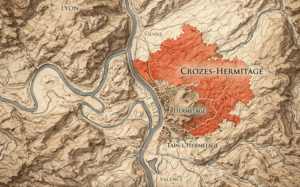 Crozes-Hermitage is Syrah’s cozy backyard, tucked along the Rhône River’s east bank in France’s Northern Rhône Valley, rubbing elbows with the iconic Hermitage hill like the popular kid’s reliable sidekick. It blankets 2,073 hectares across 11 communes—Crozes, Mercurol (where Combat calls home), Gervans, Larnage, etc.—plopped right on the 45th parallel, where vines usually decide to get serious. Hills undulate like a rollercoaster, terraces stack up like Jenga, and plateaus yawn wide, all crashed by cherry trees, apricot groves, green fields, forests and protected areas with rare plant species. Then comes the Mistral, that relentless wind beast, blow-drying the grapes, shooing away clouds, and slapping down disease.
Soils read like a mad scientist’s cookbook: southern galets roulés (pebbles that suck up sun like solar panels), northern sandy loess and granite, clay-limestone slathered everywhere. The cool north side reveals red-fruit fireworks, while the blustery south gives way to ripe blackberry thunder. Romans grew grapevines here 2,000 years ago. Today, the region churns out 89% red (Syrah running the show) and 11% white (Marsanne/Roussanne), with 75 independent winegrowers contributing to 83,000 hectolitres a year, 18% of which are exported.
And for those who like their food and wine unadulterated, two-thirds of the wineries are organic or biodynamic, courtesy of pioneers who went green in the 1950s—back when most folks thought “organic” meant hugging trees. And the number is growing fast.
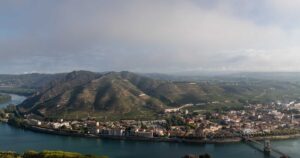
Looking over Cave de Tain, with the famed Hermitage Hill as the backdrop.
WineAlign’s Sara D’Amato provided a masterclass at the Toronto event for a lucky group, where we got to sample high-quality stuff from Combat, Yann Chave, Les Bruyères, Paul Jaboulet Aîné, Domaine du Colombier, Cave de Tain, and Domaine du Murinais. What does she like about the grape? “I love its clear expression of place—that’s something that’s quite important to me,” D’Amato says. “It’s a grape variety that is quite reflective of place, like Pinot Noir. And we’re talking about Syrah’s homeland here. It’s a benchmark for a reason. No other place produces Syrah quite like this. It’s easy to identify in a blind tasting. And there’s such a diversity of style in one grape variety. You can blend it, but it’s so expressive on its own.”
And Sandra Combat? Well, she’s admittedly a tad biased. “I was very lucky to be born in Crozes-Hermitage.”

Leave a Reply
Your email is safe with us.