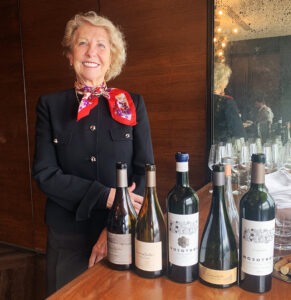
Legendary Argentinian winemaker Susana Balbo at Canoe restaurant in Toronto.
Winemaking isn’t exactly nuclear science—it’s tougher than that. At least it may have seemed that way for Susana Balbo, who wasn’t merely Argentina’s first female winemaker, but who also elevated the local white grape Torrontés from a blending variety into a national star.
Balbo initially wanted to study nuclear physics at university, but it wasn’t available in her home province of Mendoza. Oenology, on the other hand… I mean, how could the study of wine not be a more viable career path in Argentina?
Well, unless you’re female, that is.
There were 33 students in her course: 18 women and 15 men. Only three graduated—Balbo being the lone female. It was 1981, and she had become the first woman in Argentina to graduate with a degree in oenology.
Balbo’s first job was at Sucesión Michel Torino in Cafayate, where a chauvinistic culture never made things easy. She worked at other prestigious wineries, including Catena Zapata and Martins in Mendoza, before founding a winery with her husband in the early 1990s. After some initial modest success, they fell victim to a significant scam involving fake insurance, which nearly bankrupted the business. Balbo persevered by negotiating with creditors and eventually decided to sell the winery amidst financial hardship and personal upheaval following her husband’s passing.
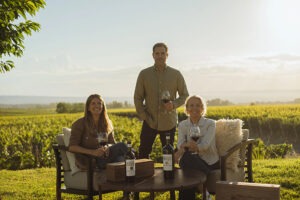
Susana Balbo (right) with daughter Ana and son José.
After that, she needed to travel. Balbo embarked on a successful consulting career, gleaning knowledge from winemakers around the globe. “That was my second university—working in France, Italy, Spain,” she says. But the best way to have her voice heard and her talents blossom was to own her own company. And so, in 1999, she founded Susana Balbo winery in Mendoza, at the foothills of the Andes.
Since then, the trailblazer has garnered multiple awards for her increasingly diverse range of wines. She has helped smaller wineries find their footing, served three terms as president of Wines of Argentina, and was inducted into Decanter’s Hall of Fame last year.
As famous as she is for her whites, one of her winery’s signature projects is Nosotros (Spanish for “Ours”)—a unique high-altitude, ultra-premium Malbec that showcases a complex and sophisticated expression of terroir.
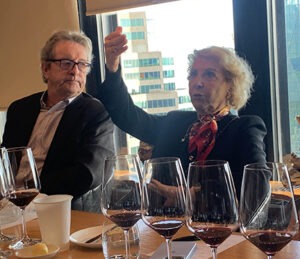
Wine critic David Lawrason of WineAlign is all ears as Balbo shares her story.
Thanks to an invite from her Ontario wine agent, Profile Wine Group, I got to chat with the Queen of Argentinian Wine last month at Toronto’s trendy Canoe restaurant on the 54th floor of the TD Bank Tower. Overlooking assorted skyscrapers, the Lake Ontario shoreline, Toronto Island and the CN Tower, it seemed a very appropriate venue, given the soaring heights Balbo has already reached.
So how was it being the first female in Argentina to graduate with an oenology degree?
I didn’t realize I was the first female. In fact, I was fishing in the middle of nowhere, and the university was looking for me. The police were blocking the road, looking for me. I got a phone call from the university asking, ‘Are you coming to your graduation?’ I said I wasn’t thinking about it at the moment, and they said, ‘You’re the only female—you must come!’”
You believe that women have an innate advantage when it comes to winemaking and detecting aromas.
“We’ve had these skills forever. It’s in our DNA—the capability to taste more flavours. It goes back to times when men were hunters and women needed to safely feed their children—to sort through the fruits, roots, herbs, and meat, which could take weeks to bring back from the hunt—and determine what was poisonous and what was safe to eat. Even among my children, my daughter Ana had more skills in capturing flavours. However, today, by training, everyone can develop the same skills. My son José is a winemaker and is now a great taster. Ana is the manager of hospitality and marketing and has developed three restaurants—two at the winery and one in our hotel. She has wonderful tasting skills. You build a library of flavours in your mind when you are interested in what you’re eating and drinking. I’ve been teaching my children since they were young about different flavours—through the fruits, vegetables and other natural foods we always ate at home—‘Keep these flavours in your mind so when you’re tasting complex dishes, you’ll know what’s in there,’ I’d tell them. I love cooking, visiting places like India, China, Japan, and bringing home different spices and teas. So they learned about complex flavours too.”
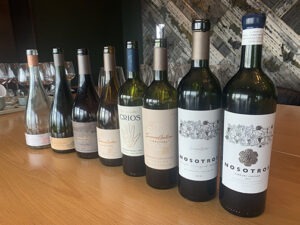
An impressive lineup of luncheon wines.
Younger people are favouring lower-alcohol wines these days. Is that something you’re looking into?
“We have a low-alcohol wine (8-9%) in the market right now. When it comes to no-alcohol wines, I’ve been researching this for four years, but haven’t found the technical process that delivers the quality that deserves a place in our portfolio. We don’t want to launch something just to please some requests. We’re waiting for the proper technology.
“Three months ago, we did a benchmark tasting with samples from across the world. It included the GoLo technology (a proprietary dealcoholization technology that uses a single-pass vacuum distillation process to remove alcohol from wine while capturing and reintegrating the wine’s volatile flavor compounds). The size of the machine needed to produce 500 litres per hour is bigger than this room—I’d need another building to house a machine just to produce a low quantity of wine. It was decent quality, though.
“The other problem is that the people looking for low-alcohol and non-alcohol wines are also looking for low calories. When you pick the grapes with less sugar—and so with less alcohol potential—the flavours haven’t yet developed. You have to achieve sugar first to ripen the seed. When the sugar level is high enough, flavours start to develop in the skin. Then the sugar starts to ripen in the seed. Physiologically, it’s an impossible task to have flavour and low alcohol and low sugar. Something has to be sacrificed.
“Further, we have to decide whether or not this is just a fad. Currently, the low-alcohol/non-alcohol drinkers are just 0.4% of the market. But I’m seeing some of these same people drinking gin and tonic with 40% alcohol levels!”
How have wine trends changed in your time as a winemaker?
“In the 1990s, wines were 14%, 15%, 16% in alcohol‚ heavy in oak, heavy in tannins. Higher-alcohol wines overpower your food and burn in your mouth. Today we’re doing much more balanced wines—12-13% alcohol, beautiful acidity, easy to drink. And my wines’ alcohol levels work well with gastronomy. In the past four months, my daughter and I have visited at least 15 two- or three-star Michelin restaurants, and all of their tasting menus were 90% white wines and 10% reds—and the reds were light. They all complemented the foods.”
You’re most famous for your Torrontés white wine, and for pushing Argentina to expand its white wine production.
“Fourteen years ago, I started what I called a White Wine Revolution. Consumption worldwide was 50% white and 50% red, but Argentina at that time was exporting 89% red and just 11% white. I felt we were missing a huge business opportunity, because we have beautiful places to grow white varieties and could produce outstanding quality. So I made a plan for innovation. The first thing I did was a barrel-fermented Torrontés, which I was the first in Argentina to try. We had several trials with several different toasted barrels to find the best combination.”
And then another innovation followed—a white wine blend. What motivated that?
“Tim Atkin (Master of Wine and influential wine journalist) asked, ‘Susana, why is there no white wine blend in Argentina?’ My answer to him was, ‘I don’t know!’ So he challenged me to do it. We created a blend of three whites: Torrontés, fermented in barrels, Semillon fermented in concrete eggs, and Sauvignon Blanc fermented in oak. The blend is then aged in second-use oak barrels for four to six months. Our White Signature blend was the only white from Argentina on the 2024 Wine Spectator Top 100 Wines list. And today, Argentina is now exporting 60% red and 40% white!”
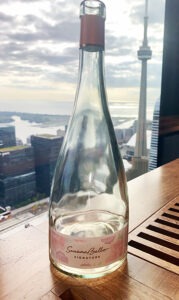
Susana’s son José led the charge in the winery’s creation of a Provence-style rosé.
After your son graduating in oenology at UC Davis and joined the winery, he inspired another revolution, which you launched in 2017—a fresh, pale, aromatic rosé.
“José said, ‘Nobody in Argentina is doing a Provence-style rosé!’ So he created a wine with (high-altitude) 60% Malbec and 40% Pinot Noir, grown expressly for rosé. The grapes are gently pressed for 15 minutes in a special press we bought. It has minimal skin contact and is fermented as a white wine.”
Apart from your influence on white wines in Argentina, you’ve also encouraged the diversification of reds beyond the staple of Malbec, particularly Cabernet Franc.
“We’ve gone from 600 hectares of Cabernet Franc in Argentina 10 years ago to around 2,000 hectares now. In France, they use it as the backbone (of a red wine blend). In Argentina, we use it for the fruitiness, while the backbone is our Cabernet Sauvignon.”
You certainly are blessed with a good climate for ripening red grapes.
“In Mendoza, we have about 350 days of sun, and in the summer the sun rises by 6 a.m. and sets around 9:30 p.m., so we have loads of sunlight.”
You credit your father for impacting your career.
“He was very important. One of his pieces of advice was to always pay your taxes (she laughs). The second lesson was that word of mouth is more important than advertising. If you depend on advertising, when you stop advertising, people stop buying your product. But word of mouth is so important. People will always malign you. One happy customer will get you two new customers. But with one disappointed customer, you will lose 10. So he told me that quality, from day one, is very important. But I am a perfectionist, so we were always in agreement there.”

Leave a Reply
Your email is safe with us.