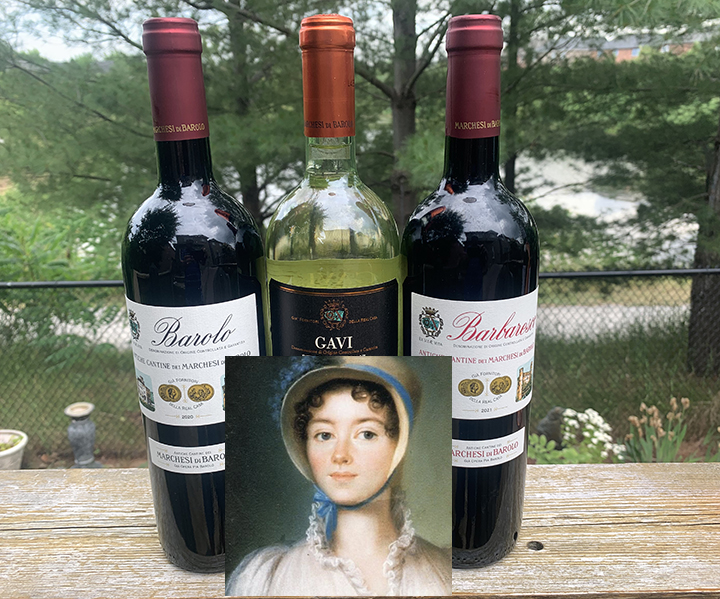
More than 200 years ago, Juliette Colbert laid the foundation for one of the great wines of the world.
There’s nothing quite like a centuries-old Italian love story involving a woman named Juliette.
Except this isn’t that love story.
This one involves Juliette Colbert of Maulévrier, France, the daughter of Count Edouard Colbert and great-granddaughter of Jean-Baptiste Colbert, who served as the finance minister of Louis XIV—a.k.a. the Sun King.
This story begins in the early 1800s, when Juliette meets the Marquis of Barolo, Carlo Tancredi Falletti, who will soon be hired as Napoleon’s chamberlain. (Needless to say, this is a serious power couple of the early 19th century.)
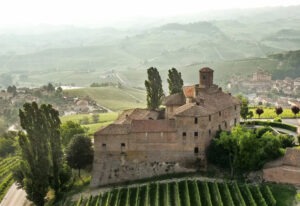
Visiting Barolo, you can find two castles: the lower one—Palazzo Barolo, which is now home to WiMu (the Wine Museum of Barolo)—and the Castello della Volta, located above the town, which Marchesi di Barolo winery is currently restoring.
Juliette and Carlo fall in love, marry in 1806 in Versailles, France, and move to Turin, Italy, where they settle at Palazzo Barolo, a magnificent Baroque palace built at the end of the 17th century.
While Tancredi brings the title, Juliette (or Guilia, as she comes to be known), brings the brains. With a firm belief that wine should not taste like vinegar filtered through a barn, Giulia quickly identifies that the soil and existing vineyards around the palace could be ideal for the indigenous Nebbiolo grape. Granted, Nebbiolo at the time is being turned into a rustic, unaged, sparkling sweet wine that is probably more suited to cleaning wounds than sipping at dinner—but Giulia has somewhat loftier standards.
So she rolls up her silk sleeves and gets to work. She consults with enologists and introduces French-style winemaking practices, soon taming the wild Nebbiolo grape into something civilized, structured, complex, preservable and borderline majestic—a wine that can go toe-to-toe with the great Bordeaux of France and is able to be transported and appreciated among European aristocracy. Giulia builds semi-underground cellars in order to allow the wine to develop in large casks while being protected from cold temperatures.
The wine becomes known as Barolo—the name of the village from which it hails.
And it catches on quickly.
“When Barolo was born, Italy was not even a country yet,” Valentina Abbona, sixth-generation vintner and Export and Marketing Manager for her family’s winery, Marchesi di Barolo, noted on the podcast XChateau four years ago. “Barolo was in the kingdom of Savoy. Thanks to the Marchese (family), the wine travelled to a number of royal courts around Europe. When it arrived in Turin, the king (Carlo Alberto, King of Sardinia and Duke of Savoy) was so curious about the wine that he asked Juliette for some. She sent 325 barrels to the king’s court—one per day of the year, less 40 days for Lent. It was from that episode that Barolo became known as the king of wines and the wine of kings.”
 Clearing Up the Royal Expression
There is admittedly some debate as to the origin of this royal tagline. My research suggests that a century before Carlo and Juliette were even born, King Louis XIV coined the expression “Vinum Regum, Rex Vinorum” (Latin for “Wine of Kings, King of Wines”), in reference to Hungarian Tokaji Aszú, one of the most prized sweet wines of the 17th and 18th centuries.
But recognizing a good branding opportunity when they saw one, Barolo producers (especially Marchesi di Barolo and others in the Langhe region), politely borrowed the expression sometime in the 19th century.
And hey, nobody could argue with their wine’s regal structure, nor the its regal stature, given that actual royalty (including the House of Savoy) drank the stuff like there was no tomorrow.
Its cost also lends itself to the kingly expression—a function of a limited production area in the Piedmont region of Italy, the intensive labour required to cultivate and then harvest the Nebbiolo grapes on the steep slopes of the Langhe region, as well as an aging process that outlasts most university degrees (a minimum of 38 months, with at least 18 months in oak barrels).
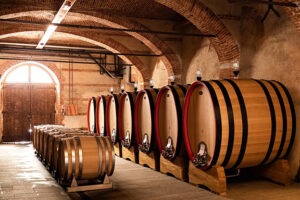
Marchesi di Barolo uses the same cellars constructed by Giulia Falletti Colbert more than 200 years ago. Its five-century-old casks remain in use.
Still Serving Nobility in a Bottle
While the wine’s matriarch is omitted in the following, the 1884 edition of the Italian Wine Journal supplied further evidence as to which family propelled Barolo to fame when it observed, “Everybody knows that the credit goes to the wines of the late Marchese di Barolo, who, when there was not even talk of exportation, thanks to his means and to his vast and high connections, was able to make his wines known in countries that nobody else could reach.”
The winery Guilia and Carlo built—Marchesi di Barolo—still stands today, right across from the Falletti castle where they lived. It’s now run by the Abbona family, who have carried Juliette’s torch into the 21st century.
And how does this Barolo wine express itself? Pale garnet in youth, while developing orangey-red brick hues as it ages, this isn’t just any red—it’s a wine that commands respect and holds onto its tannins like it’s clinging to the edge of a cliff. Far from a casual sipper, it smells like tar (yes, tar), roses, dried herbs and long walks through history. It tastes like red fruit and tension. Young Barolo can be a bit, well, assertive. (Translation: It’ll punch your palate, take your lunch money and demand that you pair it with truffle risotto.) But give it time, a good decanter and some patience, and it opens up into something profound and flexible. If you’ve ever sipped a glass of Barolo and thought, “Wow, this wine has more personality than most people I know,” you’re not wrong.
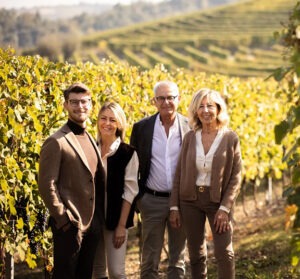
The Abbona family purchased the winery in 1929. Today, with Ernesto and Anna, and their children Valentina and Davide, winemaking has been in the family for six generations.
And Marchesi di Barolo’s versions? They’re excellent blueprints—structured and elegant, with that classic Barolo depth and confidence that says, “Yes, I might cost more than your dinner, but I’m worth it.”
The Final Sip
And in case this love story isn’t already juicy enough for you, Juliette also goes on to fund hospitals, orphanages and schools, and, according to Piedmonte Italia, transforms Palazzo Barolo into a refuge for the poor and destitute. Prior to her death in 1864, Marquise Giulia, widowed and without heirs, establishes the Ente Morale Opera Pia Barolo charity, to which she gifts of all her properties to perpetuate her many philanthropical initiatives.
Yes, she not only invents modern Barolo but is basically a one-woman social safety net too. All while wearing a corset.
So the next time you swirl a glass of Marchesi di Barolo, remember that you’re not just drinking wine; you’re drinking a revolution in a bottle, a best-selling historical romance, and the legacy of a woman who walked into an Italian village and said, “I can fix this.”
So, “Santé, Juliette—you absolute legend!” You developed the king of wines, but you were its true monarch.
Here are a few standouts to savour from the winery.
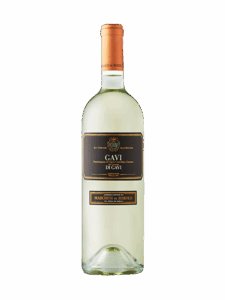 Marchesi di Barolo Gavi del Comune di Gavi 2022 — Piedmont, Italy ($26.95)
Yes, Marchesi di Barolo makes white wines too—and this one is exceptional. Fashioned from the Cortese grape, this is summer in a linen suit. On the nose, it’s all Amalfi Coast flirtation: bright citrus, green apple, white peach and a whisper of wild herbs. On the palate, it grows on you fast, with a clean, flinty edge providing backbone. And just when you think it’s all zippy fun, it throws in a saline wink and an almondy goodbye. Pair it with pesto pasta, grilled shrimp or sun-drenched daydreams. 92
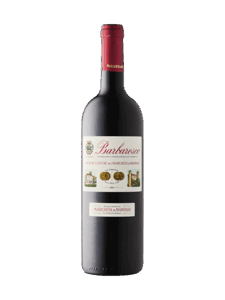 Marchesi di Barolo Barbaresco 2021 — Piedmont, Italy ($43.95)
Grab a shovel and dig past the herbs and earth to get to the dark red fruit and you’ll strike gold. Think “feminine version of Barolo,” with way more food-pairing flexibility. From the first swirl, this wine struts out of the glass like it owns the runway—cherry-red heels clicking with confidence. The nose is a glorious high note of stewed cherries and dried roses, with a whiff of tobacco and medicinal herbs. On the palate, it’s all about elegance with attitude. Those classic Nebbiolo tannins are here, but they’ve mellowed just enough to let the red currant and raspberry compote do their dance. It’s simultaneously bold and refined—like if Sophia Loren made a cameo in Downton Abbey. Decant for an hour, or let it boss you around straight from the bottle. I could drink this all week. It’s complex and intriguing without ever overwhelming the conversation. And it can age for 10 years easily. 93
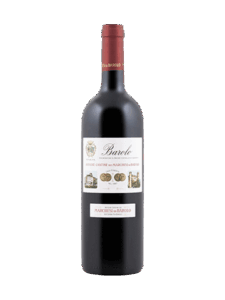 Marchesi di Barolo La Tradizione Barolo 2020 ($52.95)
Seductively translucent, this one doesn’t just walk into the room—it arrives. It’s old-school charm with a grin. On the nose, it’s a brooding mix of dried cherry, crushed violets, leather-bound books and the faint echo of a cigar smoked after a long family dinner. But take a sip, and this full-bodied Barolo flexes its muscles. It has the Nebbiolo grape’s signature grip wrapping around flavours of tart cherry, balsamic strawberry, licorice and a hint of cedar. But those tannins are anything but overpowering—more like an iron fist in a velvet glove. The finish is quite long, which is just as well, since if you’re drinking Barolo with dinner, it’s unlikely that you’ve got something like the kids’ soccer practice planned afterward. Pair it with aged parmesan, braised short ribs…or anything served after a dramatic family toast. 91

Leave a Reply
Your email is safe with us.