Last weekend I heard someone say, “Oooo—a Beaujolais,” and I wondered, “Do they know what the actual grape is in that wine?”
After all, here in Ontario, we don’t say, “I’ll have a glass of Niagara-on-the-Lake,” because the region features a myriad of grape possibilities. But in France (and many other places in Europe), you actually ask for a place, because that region is defined by specific grapes.
Let’s translate a few of the biggest hits.
BEAUJOLAIS
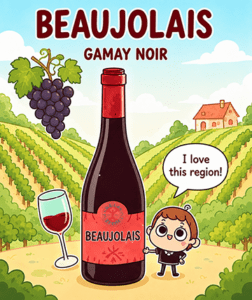 Start with Beaujolais, the gateway red for people who claim they “don’t usually like red wine.” What they mean is they don’t like tannin, oak or anything that feels like chewing a bookshelf. Beaujolais is almost always Gamay Noir—light-bodied and joyfully fruit-forward with a savoury acidity. It’s the reason Beaujolais Nouveau exists (for better or worse), and the reason serious cru Beaujolais can punch way above its weight. When someone says they love Beaujolais, what they’re really saying is: “I like red wine that behaves like a crisp white.”
BURGUNDY
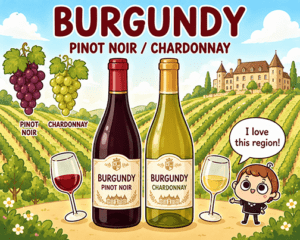 Then there’s Burgundy, which is less a region and more a lifelong commitment to confusion. Yes, they grow Gamay and Aligoté (a dry white). But Red Burgundy? That’s Pinot Noir. White Burgundy? Chardonnay. That’s it. Two grapes, infinite nuance, and a pricing structure that escalates from “reasonable Tuesday night” to “second mortgage” in about three appellations. The irony is that people will claim they adore “White Burgundy” while also saying they don’t like Chardonnay. What they actually don’t like is heavily oaked, buttery Chardonnay. Burgundy’s version—especially from cooler sites—can be taut, mineral and restrained. Same grape, completely different personality.
BORDEAUX
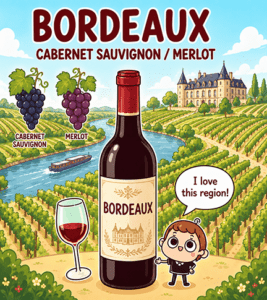 Bordeaux, meanwhile, is where things get diplomatically vague. Ask someone what’s in their Bordeaux and you’ll often get a shrug followed by “Cabernet?” In reality, Bordeaux is a blend—typically Cabernet Sauvignon, Merlot, Cabernet Franc and occasionally Petit Verdot or Malbec. The proportions shift depending on which side of the Gironde river you’re on, but the key point is this: When people say they love Bordeaux, they’re really saying they like balance, structure and the interplay between grapes. Or they just like saying “Bordeaux,” which admittedly sounds more impressive than “a medium-bodied red blend.”
CÔTES DU RHONE
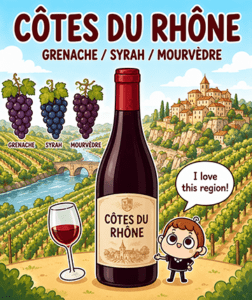 Côtes du Rhône is the region people reach for when they want something “interesting” but not intimidating. It’s the wine equivalent of ordering the chef’s special and trusting it will work out. The dominant grape here is Grenache, usually supported by Syrah and Mourvèdre—the famous GSM blend. It’s warm, spiced and generous, often with a peppery edge. When someone says they love Côtes du Rhône, what they’re actually responding to is Grenache’s plush fruit and alcohol warmth, even if they couldn’t pick Grenache out of a lineup. Looking for serious value in a French wine? This and Beaujolais are great places to start.
LOIRE VALLEY
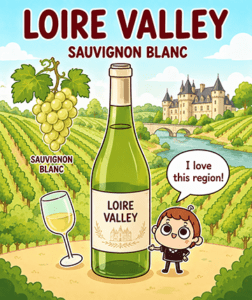 And then there’s the Loire Valley, the stealth contender in this whole exercise. People will confidently declare their love for “Sancerre” or “Pouilly-Fumé” without realizing they are, in fact, talking about Sauvignon Blanc. Crisp, citrusy, sometimes flinty Sauvignon Blanc. The same grape they might dismiss elsewhere as too grassy or sharp suddenly becomes “elegant” and “minerally” when wrapped in a Loire appellation. It’s a rebranding exercise that France has perfected over centuries.
This isn’t to mock anyone—well, not entirely. The French system was never designed to make things easy for consumers. It prioritizes place over grape, terroir over transparency. For professionals and enthusiasts, that’s part of the appeal. For everyone else, it’s a bit like ordering off a menu where the ingredients are implied but never listed.
The funny part is how often people already know what they like—they just don’t know how to name it. The Beaujolais fan likes Gamay’s freshness. The White Burgundy devotee likes cool-climate Chardonnay. The Bordeaux loyalist enjoys structured blends. The Rhône drinker gravitates toward Grenache’s warmth. The Sancerre enthusiast? Sauvignon Blanc, through and through.
Once you decode it, the whole system becomes less intimidating and a lot more useful. Instead of memorizing hundreds of appellations, you start to see patterns. You realize that liking one region often opens the door to others using the same grape in a different style. Suddenly, you’re not just ordering confidently—you’re ordering intelligently.
Of course, there’s still something charming about sticking with the regional shorthand. Saying “Let’s get a Burgundy” carries a certain romance that “Let’s get a Pinot Noir” just doesn’t. One sounds like a decision; the other sounds like a spreadsheet.
So by all means, keep ordering by region. Just know that behind every French place name is a grape quietly doing the heavy lifting. And once you know who that is, you can start making choices that go beyond the label—and maybe even impress the table while you’re at it.
Or at the very least, you’ll finally be able to answer the question: “What do you actually like?”
And that’s a much more useful kind of wine confidence.


Leave a Reply
Your email is safe with us.