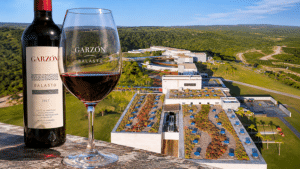
Bodega Garzón was the first LEED-certified winery outside North America.
What do a proposed wind farm, an Argentinian billionaire, some ancient granite and a rather temperamental red grape have in common?
They’re all part of the story behind one of South America’s most fascinating wineries—and it’s not in Argentina or Chile.
Earlier this month, at the Mark Anthony Fine Wine & Spirits Salon at Toronto’s Harbour 60, a remarkable showcase of exceptional wine, Scotch and rum, I joined Germán Bruzzone, head winemaker at Uruguay’s Bodega Garzón, for a vertical tasting celebrating a decade of the winery’s flagship wine, Balasto.
As it turns out, the story behind the winery is every bit as intriguing as the wines themselves.

Germán Bruzzone, head winemaker at Uruguay’s Bodega Garzón.
Gone with the wind
Some 9,000 kilometres south of Toronto, in the rolling hills of southeastern Uruguay, Argentinian oil magnate Alejandro Bulgheroni once contemplated building a wind farm.
So what prompted the change of plans? “His wife,” Bruzzone explains with a smile.
Apparently, Bettina Bulgheroni wasn’t particularly enamoured with the prospect of wind turbines interrupting the magnificent views from their property. Fortunately for wine lovers, another use for the land was found. With encouragement from friends and the expertise of renowned Italian winemaking consultant Alberto Antonini, the Bulgheronis turned their attention to viticulture. The first vines were planted in 2008, and the spectacular winery officially opened in 2016.
Ironically, the very winds that made the property attractive for a wind farm would become one of its greatest assets as a vineyard.
Location, location, location
Situated just 18 kilometres inland from the Atlantic Ocean, not far from the glamorous seaside destinations of Punta del Este and José Ignacio, Garzón benefits enormously from its maritime location.
“Winds are very important for us,” says Bruzzone. “They bring salinity, the salty note that comes from the ocean.”
The cooling ocean breezes also help preserve the grapes’ natural acidity, something Bruzzone considers fundamental to producing wines that make you want to keep coming back for another sip.

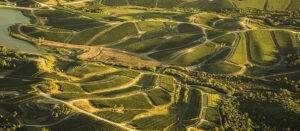
Bruzzone points out characteristics of some of the winery’s 1,100 plots.
And what lies beneath the vines is every bit as important as what blows across them. The vineyards sit on weathered granite derived from rock dating back some 2.5 billion years. Known locally as balasto, this sandy, rocky material provides excellent drainage—a particularly important attribute given Uruguay’s generous rainfall.
“The drainage is incredible,” Bruzzone beams.
The vineyards are divided into hundreds of individual plots, each with its own combination of slope, sun exposure and microclimate. Even the same grape variety can produce markedly different wines depending on where it’s planted. And with 16 grape varieties and some two dozen different wines in Garzón’s portfolio, Bruzzone certainly has plenty to work with.
It all makes for an extraordinary natural laboratory for a winemaker.
From wind power to wine power
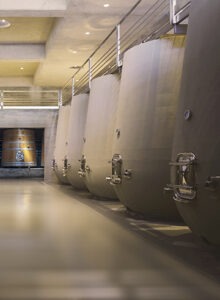
Balasto is fermented in epoxy-free concrete tanks, then aged 20 months in oak, although the oak influence is judicious.
Garzón’s respect for its natural surroundings extends well beyond the vineyards. At 205,000 square feet, with a capacity of 2.2 million litres, there’s nothing small-scale about the winery itself. Yet the spectacular facility became the first winery outside North America to achieve LEED (Leadership in Energy and Environmental Design) certification.
Built into the hillside, the winery employs a gravity-flow design that reduces the need for mechanical pumping, while its underground spaces help regulate temperatures naturally. Renewable energy and responsible water management are also part of the sustainability equation.
It seems the Bulgheronis didn’t entirely abandon their green ambitions when they traded wind turbines for wine barrels.
That same philosophy of working with nature rather than against it extends to what Bruzzone does in the vineyard and the cellar, particularly when it comes to Uruguay’s signature grape.
Taming Tannat
Uruguay has considerably more cattle than people. It’s a country that takes its barbecues seriously, which helps explain its longstanding love affair with Tannat, a notoriously tannic red grape.
If you’ve ever encountered an old-school Tannat that seemed capable of stripping the enamel from your teeth, you’ll appreciate what Bruzzone and his team are trying to accomplish.
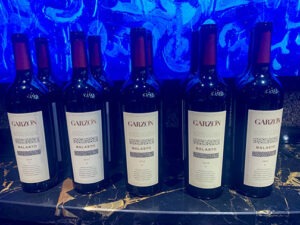
Our vertical tasting lineup of Balasto.
“We changed the place where we grow Tannat, and we changed the way we produce it,” he explains.
Garzón’s winemaking philosophy revolves around five guiding principles: minimizing synthetic chemicals in the vineyard, avoiding excessive ripeness, avoiding excessive extraction, using oak judiciously and intervening as little as possible in the winemaking process.
Bruzzone is particularly adamant about oak. “If you over-oak the wine, you lose its identity,” he stresses.
Coffee, chocolate and vanilla might be appealing characteristics in a wine, but as Bruzzone points out, they don’t necessarily come from the place where the grapes were grown.
After all, when you’ve got 2.5 billion years of geology and the Atlantic Ocean working in your favour, why mask their influence with a barrel?
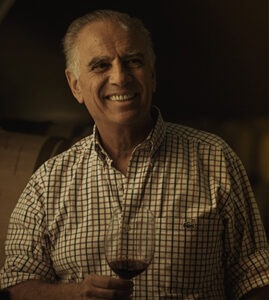
Garzón Founder-Alejandro Bulgheroni.
Ten years of Balasto
Perhaps the most compelling expression of that philosophy is Balasto, Garzón’s flagship red, named after the estate’s distinctive granitic soil.
Fermented in cement tanks and aged for 20 months in untoasted French oak barrels, Balasto is not a wine that tiptoes into the room. It’s a full-on, full-bodied red with broad shoulders, yet there’s a freshness and finesse to all that power.
The inaugural 2015 vintage comprised Tannat, Cabernet Franc, Petit Verdot and Marselan. Subsequent vintages have also incorporated Merlot, with the proportions and grape varieties changing according to the growing season.
“It’s not a recipe,” explains Bruzzone. “It’s an interpretation of the year and an interpretation of the place.”
Interestingly, a wine that tastes magnificent on its own doesn’t necessarily earn a place in Balasto. Bruzzone recalls how an excellent Marselan was excluded from one vintage simply because it didn’t work in the overall blend.
Mother Nature also has a considerable say in what goes into the bottle. In 2017, late-season rainfall meant Petit Verdot didn’t make the cut, while the earlier-ripening Merlot did. In particularly challenging years, Balasto isn’t produced at all.
Argentina has its Malbec. Chile has its Carménère. And Uruguay? Garzón is doing its part to put its stamp on Tannat. (BTW, the winery’s Reserva Tannat is just $24.95 at the LCBO, but stock it very low right now.)
Who would have imagined that a wind farm that never got built could have contributed so much to the world of wine?




Leave a reply