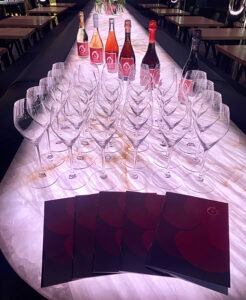
The entrance display at Wednesday’s Lambrusco event at Toronto’s Cassius restaurant was admittedly eye-catching.
I owe Lambrusco an apology. Not the casual Canadian kind, where you say sorry because someone else has stepped on your foot. A proper apology, involving an admission of prejudice and, preferably, another glass.
Before Wednesday’s media lunch at Toronto’s Cassius restaurant, I wasn’t much of a fan. Lambrusco occupied a dusty mental shelf labelled “Sweet, fizzy red things,” somewhere beside youthful indiscretions and wine purchases influenced by unusually shaped bottles. It was essentially a bottle of tart cherry juice I’d forgotten in the fridge for three months that had started to spontaneously ferment.
Then along comes the Consorzio Tutela Lambrusco, the organization that represents and promotes Lambrusco producers. Its campaign is called “More Than One Shade.” By lunch’s end, I understood the point. I had arrived with one opinion and was leaving with several new ones, all considerably more flattering.
With wine educator/consultant/sommelier/podcaster Sara d’Amato guiding the proceedings, we explored Lambrusco ranging from delicate pink to deep purple, from Champagne-like elegance to lightly tart spritzes—all easy-drinking and food-friendly. (Even Sara couldn’t recall such a dedicated Lambrusco showing in Toronto in the past decade.)
Older than its reputation
Lambrusco encompasses a family of 12 indigenous dark-skinned grape varieties, rooted in Emilia-Romagna, Italy. Depending on the appellation and producer, they can appear individually or in blends. Its history reaches back to the agricultural traditions of Modena and Reggio Emilia. The consortium’s historical account points to classical writers including Virgil, Cato and Varro, who described “labrusca vitis,” wild vines growing around field margins.
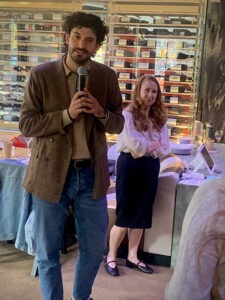
Alessandro Medici, fifth-generation winemaker and co-owner of the historic Medici Ermete winery, with the event’s presenter Sara d’Amato.
This isn’t to say that Roman dinner parties featured today’s bottled fizz. Still, the connection to place runs deep. Centuries later, sparkling local wines were attracting written attention. In 1597, physician and author Andrea Bacci described pleasantly sparkling wines from the countryside between Modena and Parma.
International success eventually brought a narrower reputation. Cheap, sweet versions became familiar enough to obscure the category’s diversity—a problem quality-minded producers have spent years challenging. There’s nothing wrong with sweet wine. But judging all Lambrusco by its sweetest examples, I now better appreciate, is like judging Italian cuisine by the dessert trolley.
Meet the Different Shades
Sorbara is the lighter-footed member of the family: often pale, fragrant and brisk, with floral character and lively acidity. Think less lumbering red wine, more sparkling conversationalist who knows when to leave you wanting another sip.
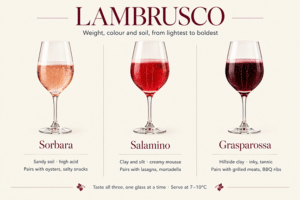
Your need-to-know Lambrusco guide.
Then there’s the question of bubbles. Tank fermentation produces the vast majority of Lambrusco, while bottle-fermented styles offer different textures and expressions. Traditional-method (Champagne-style) examples exist, too, including Paltrinieri’s zero-dosage Grosso.
Colour, sweetness, grape, texture, fizz: suddenly that supposedly simple category starts looking wonderfully complicated. Fortunately, drinking it needn’t be, and a few representatives were present at Wednesday’s event to help put faces to the bottles. Alessandro Medici, fifth-generation winemaker and co-owner of Medici Ermete, represented a family deeply involved in Lambrusco’s quality revival. Alberto Paltrinieri brought another substantial family story: his winery began in 1926 and is celebrating its centenary! Also present was Antonella Pagnanelli, export manager for Riunite, sharing some background behind the bottles.
The consortium itself is comparatively youthful. Created in January 2021 through the merger of three previous organizations, it represents six designations across Modena and Reggio Emilia. Ancient roots, but a newer organizational chart.
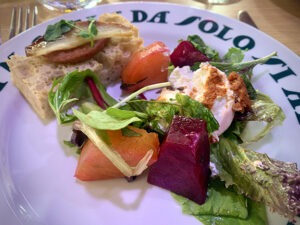
The food quality matched the wines at Cassius.
A wine that understands lunch
Cassius supplied convincing edible arguments: burrata with beets and honey vinaigrette; calamari with lemon mayo; baked goat cheese with pistachio; and homemade mushroom tagliatelle with Parmigiano Reggiano, butter and sage. This was an education with excellent catering.
The wines’ freshness and fizz kept the experience lively rather than ponderous. Many Lambruscos sit around 11% alcohol, and that relatively modest weight suited the afternoon’s easygoing character.
Food-friendly, certainly. But also friend-friendly: wines that encourage conversation rather than demand everyone stop talking while somebody identifies an elusive forest-floor aroma. (OK, I’m admittedly that guy, sometimes.)
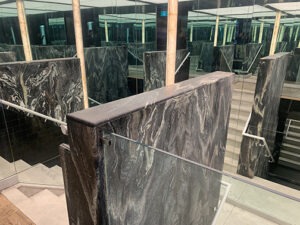
The mirrored stairway down to the restrooms at Cassius can be somewhat distracting.
That was the revelation. Lambrusco can be interesting without making enjoyment feel like homework.
My final photograph wasn’t of a bottle. It was Cassius’s reflective passage downstairs to the restrooms—a house-of-mirrors moment that seemed appropriate after an afternoon of revised perceptions.
There were suddenly several versions of me looking back.
Every one of them owed Lambrusco an apology.



Leave a Reply
Your email is safe with us.